
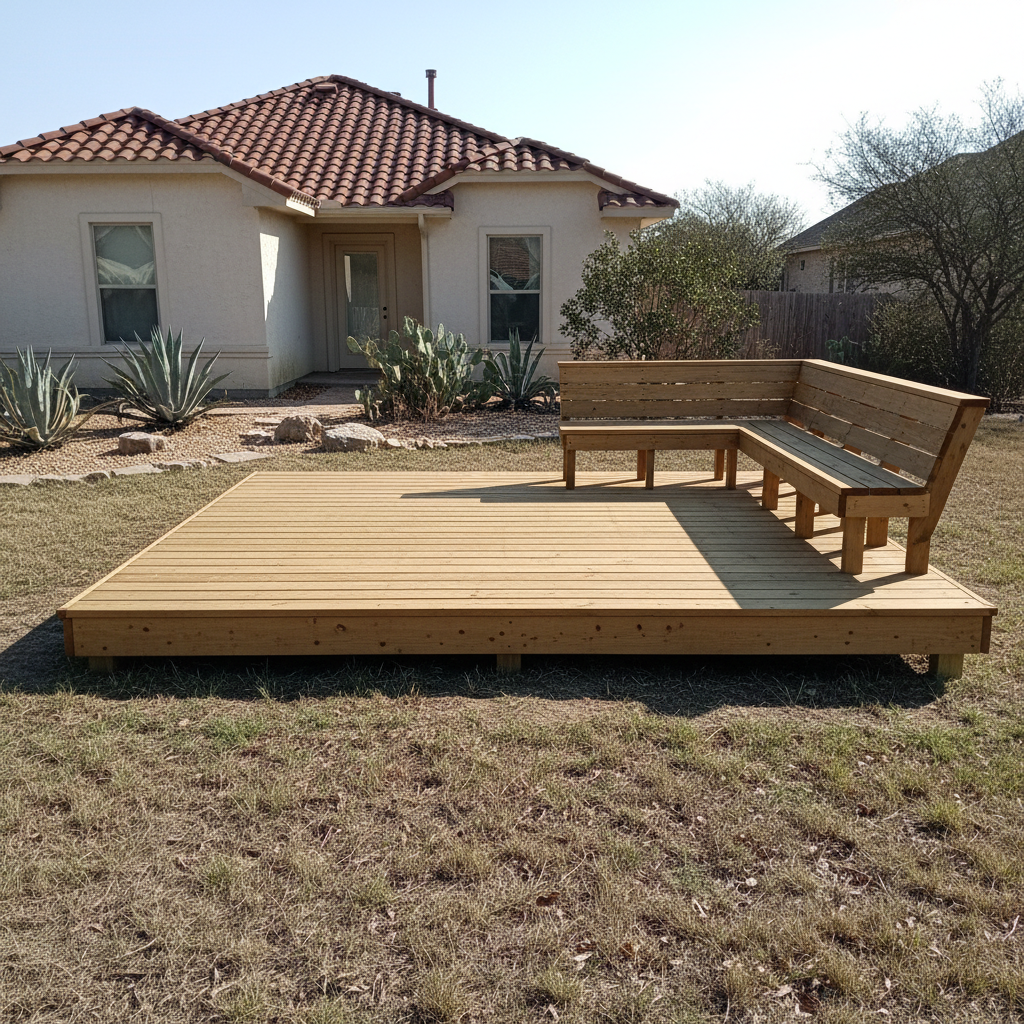
Socorro sits on ground that doesn't make building easy. Most lots here have a layer of caliche a foot or two down, that chalky white hardpan that's basically cemented calcium carbonate. A post hole digger bounces off it. A lot of crews either don't know it's there until they hit it, or they know and try to shortcut the dig anyway. That's the first thing to ask any builder you're talking to: how are you setting the footings, and have you dealt with caliche before.
A deck is only as good as what's under it. Everything above grade, the decking, the railing, the stain, can be redone in a weekend. The footings can't be, not without tearing the whole structure apart. So this post is less about picking a color of composite board and more about how to tell, before you sign anything, whether the person in front of you actually knows how to build a deck that stays put.
What the ground and the weather do to a deck here
El Paso County doesn't have a deep frost line the way the Midwest does, but we do get freeze events, including multi-day hard freezes like February 2021. Footings here are usually set 12 to 18 inches below grade depending on soil and local code, which is shallower than you'd see in a northern state, but caliche changes the math. If it's not broken up and the footing isn't bearing on solid material, you get movement, and a deck that rocks or a post that leans within a year or two.
Then there's the heat. Summer highs sit in the upper 90s and past 100 from June through August, with concrete curing fast and losing moisture before it reaches real strength if nobody's watering it down. A footing poured in July needs to be kept damp for several days or it cures weak on the outside. Monsoon season, mid-July through September, brings short, hard downpours that dump an inch of rain in under an hour on ground that's bone dry the rest of the time. That matters for grading. If the deck framing sits flush to grade or the yard slopes toward the house instead of away from it, that water finds the posts, the ledger board, and eventually the house itself.
Permits and inspections, how it actually goes
Decking work in Socorro generally needs a building permit through the city, or through El Paso County if you're just outside city limits, and most attached decks trigger at least two inspections: one after the footings are dug and before concrete goes in, one for the framing before the decking boards cover it up. A builder who tells you permits aren't needed, or that they'll just "keep it quiet," is telling you they plan to skip inspections that exist specifically to catch bad footings and undersized framing before you're standing on it. If your lot is in one of the newer subdivisions off Alameda or Horizon, there may also be an HOA with its own setback or material rules, so it's worth checking your covenants before design even starts. Older streets, especially homes built before the 1990s, often don't have a survey on file that matches what's actually there, so a decent builder will walk the property line before anything's dug, not assume the old fence marks it.
Questions worth asking before you hire anyone
- How deep are you setting the footings, and what's the diameter of the concrete pier?
- Are you using pressure-treated posts rated for ground contact, or just standard PT lumber?
- What's your joist spacing, 16 inches on center or wider?
- How is the ledger board attached to the house, and is it flashed?
- What fasteners are you using, hot-dip galvanized or stainless, and are they rated for whatever decking material I'm choosing?
That ledger question matters more than people think. A deck that's pulled away from a house, the kind of collapse story that makes the news, is almost always a ledger that was nailed instead of bolted, or bolted without flashing, so water got behind it and rotted the house rim joist for years before anyone noticed. A builder who can answer that question in one sentence, without hesitating, has done this before.
Signs it's time to walk away
If a quote comes in verbal only, with no line-item breakdown of materials versus labor, that's a problem. You want to see lumber species and grade written down, not just "wood." If someone quotes a full custom deck over the phone without ever walking your yard, they're guessing, and you'll find out later what they guessed wrong about, usually the slope or a buried utility line. Ask who pulls the permit. If the answer is "you do," understand that you're now the one legally responsible for the inspections passing, not them.
Be wary of anyone pushing you hard toward the cheapest decking option without asking what you actually want from the deck. Pressure-treated pine is a fine, honest material, but it needs re-staining every 2 to 3 years out here because UV at this elevation and this little cloud cover breaks down wood fiber and finish fast. Composite costs more up front, generally doesn't need staining, but it does expand and contract with our temperature swings, 100-degree days into 60-degree nights in spring and fall, so it needs the gap spacing done correctly at install or you get buckling in a year. A builder should tell you that tradeoff unprompted, not wait for you to ask.
What a reasonable timeline looks like
For a straightforward attached deck, footings dug and poured, then a few days of cure time before framing loads onto them (concrete needs roughly 3 to 7 days before it should carry real weight, even though full strength takes closer to 28 days), then framing, decking, and railing. All told, a mid-size project usually runs two to four weeks once the permit's in hand, longer if caliche slows the dig or if a summer downpour shuts down a pour day. Anyone promising a full custom deck in three days start to finish is either doing something smaller than you think or skipping steps you won't see until something fails.
None of this is complicated once you know what to look for. It's mostly about whether the person bidding your job has actually fought this ground before. We've built and repaired decks across Socorro and the surrounding towns long enough to know where caliche usually sits on a given street and how the summer heat changes a pour schedule. If you want someone to walk your yard and tell you straight what it'll take, Champion Deck Company is a good place to start that conversation.